

Eight months before Brazilians vote in one of the most consequential presidential elections in the country’s recent history, President Luiz Inácio Lula da Silva finds himself in a position that would have seemed impossible twelve months ago—bruised but competitive, embattled but optimistic, and fighting on three fronts: a trade war with Washington, a new banking scandal, and a country that remains deeply divided.
Welcome to Brazil in 2026—Latin America’s largest democracy, its most complex economy, and the year’s most unpredictable electoral battleground.
A Statistical Draw With Only Eight Months Until the Race
Recent polling shows 48% of Brazilians approve of Lula’s government and 49% disapprove—a statistical tie that tells the story of a president who has neither collapsed nor consolidated, hovering just above the threshold of political survival.
It has been a turbulent road to get there. In the first half of 2025, food inflation pushed his numbers toward the floor. Then something unexpected happened: Donald Trump came to Lula’s rescue.
In July 2025, the Trump administration imposed a 50% tariff on Brazilian imports, citing the ongoing trial and the alleged political persecution of Lula adversary, former President Jair Bolsonaro, for his alleged role in a coup attempt in January 2023—framing a trade penalty in nakedly political terms.
The move backfired inside Brazil. Rather than pressuring Lula, Trump’s tariff threat was perceived by many Brazilians not as a criticism of their government but as an external assault on national sovereignty. Lula’s response allowed him to assume the posture of a statesman defending Brazilian “dignity” in the face of North American pressure, mobilizing support beyond his traditional political base.
By November, Trump lifted significant tariffs on Brazilian agricultural products, acknowledging what he called “initial progress” in trade talks following a sit-down with Lula on the sidelines of the ASEAN Summit in Malaysia in late October.
In December, the Trump White House lifted sanctions on the controversial figure of Alexandre de Moraes, a Justice of the Supreme Federal Court in Brasília, who was the target of U.S. sanctions under the Magnitsky Act in July for his role in Bolsonaro’s prosecution.
But relations between the two American nations never mended completely.
In January 2026, Lula publicly criticized U.S. military intervention in Venezuela, posting on social media that Washington’s actions crossed what he called “an unacceptable line,” warning the region of an impending “humanitarian catastrophe” in the event of a U.S. intervention into Caracas.
The two leaders remain in an uneasy coexistence—transactional where necessary, but adversarial when politically convenient for both. Trump, rallying his conservative base at the head of a crusade to absolve the Western Hemisphere of left-wing excesses and abusive statism, and Lula, vowing to fend off the U.S. hegemony to placate the more extreme progressive wing of Brazil’s liberal sentiments.
The Economy: Resilient But Fragile
Brazil’s macroeconomic picture heading into the election is a study in contrasts. Growth is modest, employment is holding, and agricultural exports remain strong. But the underlying fiscal picture is less comfortable.
Brazil’s interest rates stand at 15%—the highest level since 2006—a rate that the markets view as essential to containing inflation, but one that imposes a punishing cost on borrowing, investment, and public debt service for citizens. The World Bank has acknowledged Brazil’s real progress in poverty reduction under the Lula government while flagging that high and rising debt leaves fiscal sustainability as a genuine medium-term challenge.
Lula’s political answer to economic pressure has been redistribution, an answer that Brazil’s conservative class despises. Lula pushed through an income tax exemption for workers earning less than the equivalent of $930 per month—a measure analysts at Americas Quarterly describe as both economically stimulative and politically shrewd, targeting precisely the lower-middle-class voters whose support will determine the election’s outcome.
The Security Situation
If the election is fought on household economics, analysts say, Lula has the advantage. If it becomes a referendum on public security—where 38% of Brazilians identified crime and violence as their top concern in a November Quaest survey—the calculus shifts against him in support of a conservative candidate.
Brazil’s crime epidemic has not been dissimilar to the difficulties that other nations in the region have faced. Rising crime in Peru, Chile, Argentina, and Ecuador has all been fueled by record cocaine prices, rates that have not been seen in years.
Colombia and Peru are still the world’s leading producers of coca, the base product for cocaine, as criminal drug gangs in South America, funded and backed by influential Mexican cartels like the CJNG and the Sinaloa Cartel, compete for territory and control of the lucrative smuggling routes that head north into North America.
The drug-fueled violence has affected Brazil, too, as local gangs vie for control of key neighborhoods, or favelas, in which these gangs operate with impunity from Brazilian security forces, allowing them access to distribute illicit narcotics.
In late October, Brazilian police and military forces launched “Operation Containment” in the Alemão favela in Rio de Janeiro, a “mega-raid” into one of Brazil’s deadliest slums, targeting suspected drug traffickers from the violent gang–Red Command (CV).
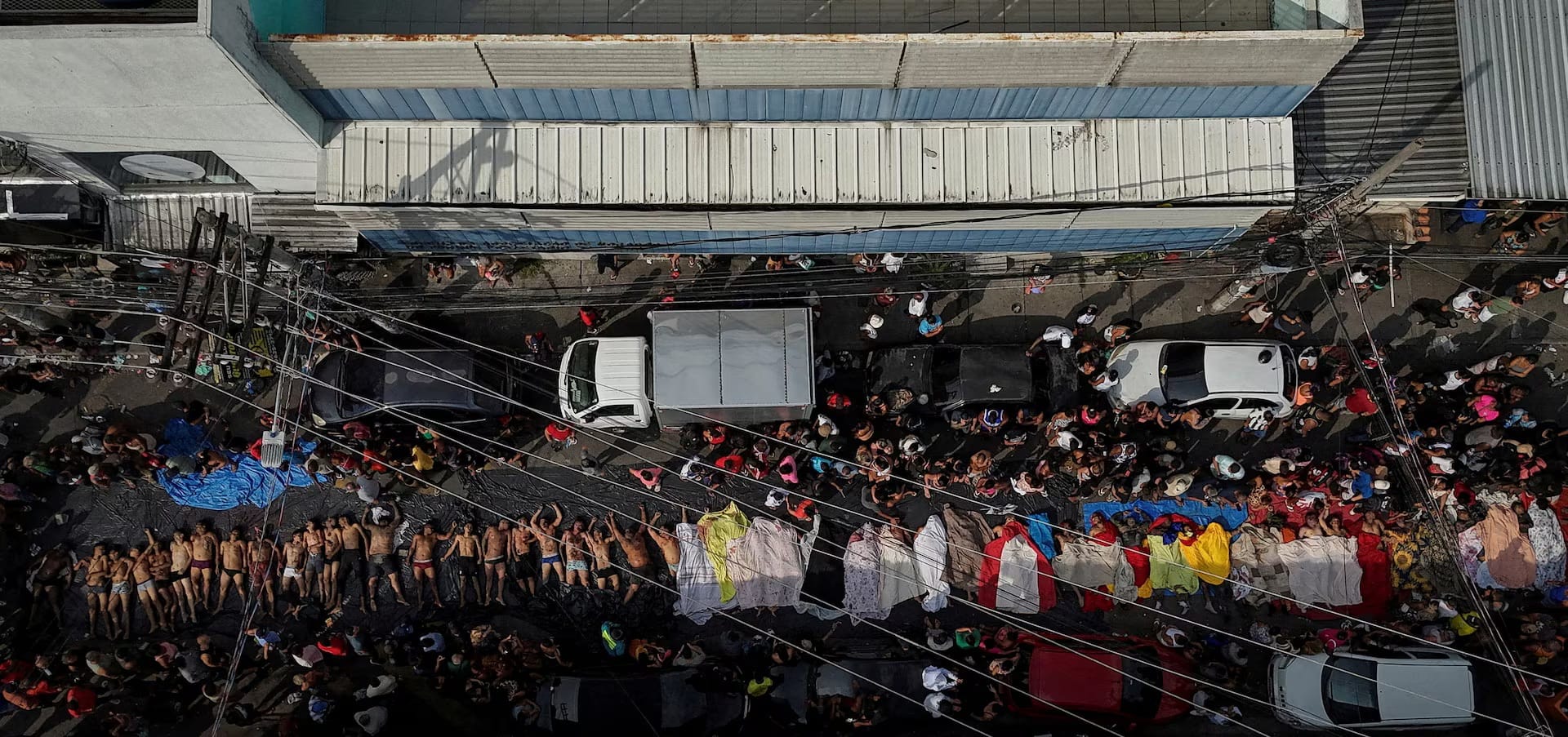
The operation became the nation’s deadliest raid in Brazil’s history, shocking the world and resulting in the deaths of over 130 people, including four security personnel.
Authorities noted that 2,500 security personnel were involved in the operation.
Critics of President Lula pointed to the government in Brasília, attributing the scale of the operation that was required to the lawlessness of the state under the left-wing Workers’ Party (PT).
The Banco Master Catastrophe
No story threatens to complicate Lula’s re-election bid more than the collapse of a large lending institution. The financial scandal began as a liquidity crisis in November 2025 and has since metastasized into what Brazilian commentators are already comparing to the Carwash corruption probe that shook the country a decade ago.
What appeared initially to be a mid-sized bank facing cash pressures became, upon closer inspection, an alleged large-scale fraud involving accounting manipulation, fabricated assets, and a web of political connections cutting across lawmakers, governors, and members of the judiciary, according to ABC News.
The architect of the scheme, according to federal investigators, was Daniel Vorcaro, 42, a financier who built Banco Master from a small institution beginning in 2018 and grew it aggressively by marketing high-yield debt instruments to retail investors and pension funds.
Vorcaro was arrested in November as he attempted to board his private jet in São Paulo, reportedly bound for Dubai, and was subsequently released under electronic monitoring while investigations continued, while the bank entered its liquidity crisis in November.
Federal Police describe the core scheme as the issuance and sale of fraudulent credit instruments, the creation of non-existent credit portfolios, and the use of those instruments to artificially inflate the bank’s reported assets—a financial house of cards that ultimately collapsed under the weight of mounting liquidity demands and mismanagement.
The bill for ordinary Brazilians is staggering. Brazil’s private deposit guarantee fund, known as the FGC and financed by the country’s major banks rather than taxpayers, faces a record payout of approximately 41 billion reais—roughly $7.6 billion—to reimburse some 1.6 million affected creditors, according to Al Jazeera.
Brazil’s central bank moved this week to ease bank reserve requirements specifically to offset the liquidity impact of the FGC’s replenishment—an extraordinary regulatory intervention reflecting the scale of the disruption.
The political tentacles of the scandal reach into Lula’s own circle. The investigation has surfaced connections between Vorcaro and lawmakers, governors, and senior judicial figures who interacted with the banker in social, business, and financial contexts—with some of those implicated identified as allies of the president.
Supreme Court Justice Alexandre de Moraes, who oversaw the prosecution of ex-President Bolsonaro, is facing scrutiny over reported contacts with the Central Bank governor during the Master crisis, with questions raised about a law firm linked to his wife receiving a contract worth approximately $24 million.
According to Covington & Burling, which has closely analyzed the scandal’s implications for foreign investment, developments in the investigation connected to members of Lula’s cabinet and party could impose a meaningful electoral cost on the president as the October vote approaches.
The Opposition: A Name Without Its Man
The right’s path to the presidency runs through a courthouse. Former President Jair Bolsonaro, sentenced in September to 27 years in prison for his role in a January 2023 coup attempt, is legally barred from running until 2030.
Bolsonaro’s chosen successor is his own son, Senator Flávio Bolsonaro, who carries the family name but not yet his father’s political base.
Current polling shows approximately 45% of Brazilians say they would never vote for Lula, while 50% say the same of Flávio Bolsonaro, giving the incumbent a narrow but consistent edge in a head-to-head runoff scenario.
São Paulo Governor Tarcísio de Freitas, widely considered the more formidable opposition figure and more experienced politician, has not yet committed to a presidential run—a hesitation that is leaving the right fractured as the campaign window narrows.
A Country Divided
Beneath the polling numbers lies a Brazil that is genuinely, structurally polarized—between evangelical and secular Brazil, between the industrial south and the impoverished northeast, between those who see Lula as the country’s indispensable social guardian and those who view him as the embodiment of corruption, economic mismanagement, and Brazilian communism.
What Brazil needs heading into this election, observers across the political spectrum largely agree, is the same thing it has always needed: substantive reforms to the lavish benefits and institutional perks that sustain a political class resistant to accountability—a reform agenda that neither Lula nor his likely opponents have shown the political will to fully pursue.
The October 4 first round election will not just choose a president. It will tell the world which version of Brazil is winning.


